
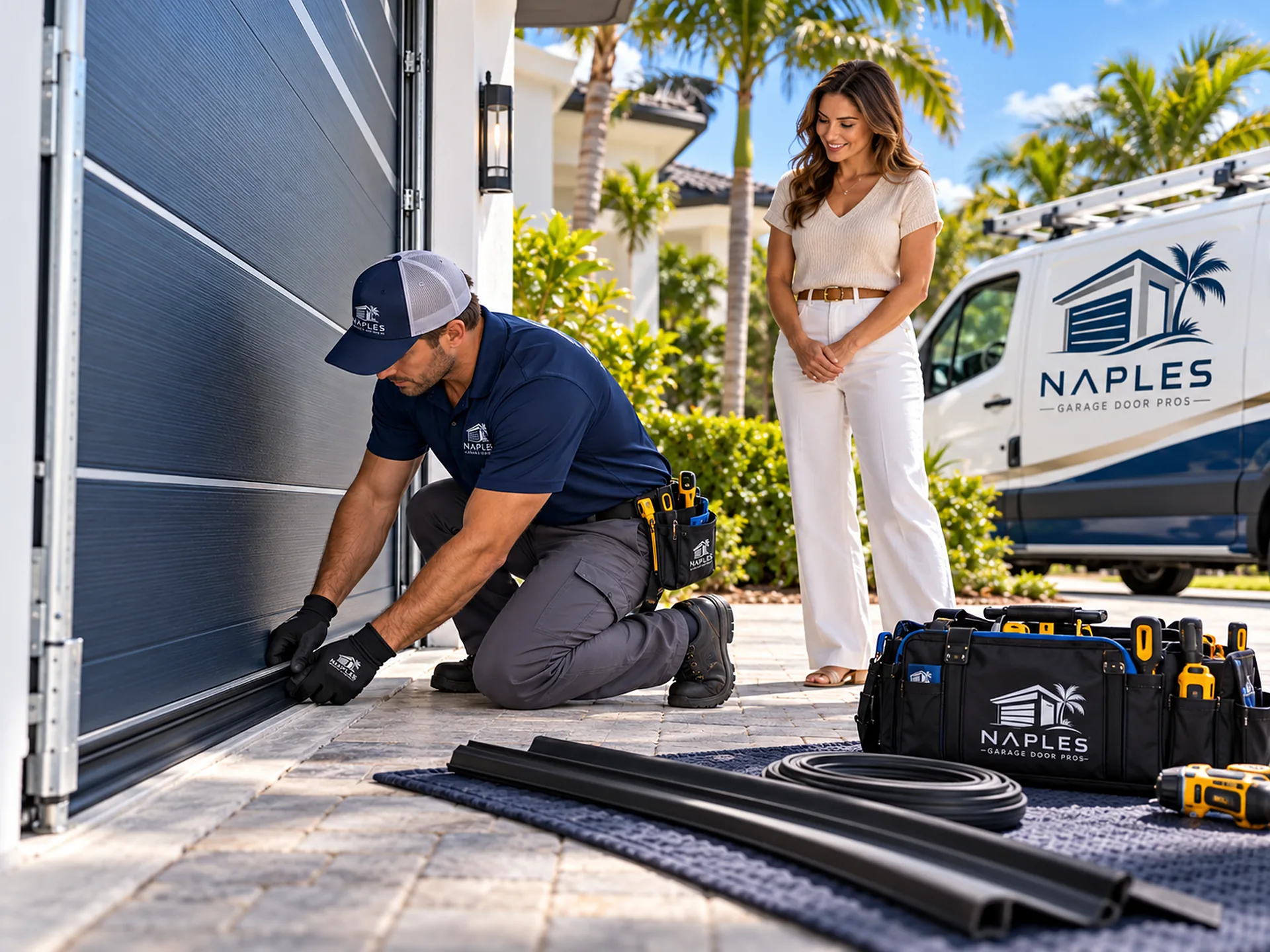
Daylight under the door? The bottom seal has had enough.
The rubber strip under the door fills the gap to the floor, and the vinyl along the sides and top closes the edges. Sun, heat and salt wear them out, and then rain, sand and bugs come right in.
- On site: About 1 hour
- Florida license CGC15***92
Signs this is your problem
- A line of daylight shows under the closed door.
- After a summer downpour, a puddle forms just inside the door.
- Sand, leaves and bits of palm frond pile up just inside the door.
- Palmetto bugs, ants or lizards find their way in along the floor.
- The rubber is cracked, flattened, torn or pulling out of its channel.
- The gap is wider at one end: the door may be hanging unevenly, a cable issue rather than the seal.
What gets replaced
The bottom seal slides into an aluminum channel, called a retainer, along the lower edge of the door. Near the water that channel corrodes too, and a new seal won't stay put in a pitted track, so we check it and replace it when it's gone. The side and top seals are vinyl strips fastened around the opening, and they're replaced once they've turned brittle or pulled away. Seals come in several shapes and widths; the technician measures yours and matches the channel on your door.
Floors that aren't level
Many garage slabs slope toward the door or dip at one corner, and a standard seal leaves a gap there. A taller, softer seal, or a threshold strip fixed to the floor, can close it. If the gap is wider at one end because the door hangs crooked, the fix is the door, not the seal, and the technician will tell you so. Unsure which one you have? The symptom guide helps.
What a seal can and can't do
A good seal keeps out wind-driven rain, sand, bugs and a fair share of the heat. Storm surge is another matter: no seal holds it back, and in Naples during Ian it reached 6 to 9 feet above ground (National Hurricane Center report). After a storm, check the seal for packed sand, tears and a bent channel before the summer rains start. A seal is never an emergency, but a door you can't close is: use the emergency line.
Questions about bottom & side seals
When it's cracked, flattened or letting light through, rather than on a schedule. Near the coast, sun and salt age the rubber faster, so look at it each year before hurricane season starts on June 1.
Usually, yes. A taller or softer bottom seal can follow a dip in the slab, and a threshold strip on the floor can close a gap the seal can't reach.
It keeps out wind-driven rain and runoff from the driveway, but not a flood or a storm surge. If water in the garage is a regular problem, the slope of the driveway and the drainage around it deserve a look too.
One number, from the first call to the sign-off
Calls and texts to (239) 990-8829 are answered by a person, day and night. Text us a picture of your door, or of the sticker on your opener, and we'll tell you the likely cause, how long the fix keeps us there and the first opening on the schedule.